Robotic. Agentic. Guerrilla.
The automation industry is arguing about two paradigms. Neither of them covers 50% of the work that actually needs automating.

The automation argument right now is RPA vs AI agents. UiPath and Automation Anywhere on one side, rebranding toward "agentic" as fast as they can. Every AI startup on the other, promising autonomous systems that handle anything with minimal human setup.
Both sides are right that the other has problems.
Both sides are talking about 40–50% of the work that actually needs automating. The other half is sitting in someone's CoE backlog, waiting.
There are three kinds of process automation. Most companies only know two.
Robotic Process Automation — the enterprise model
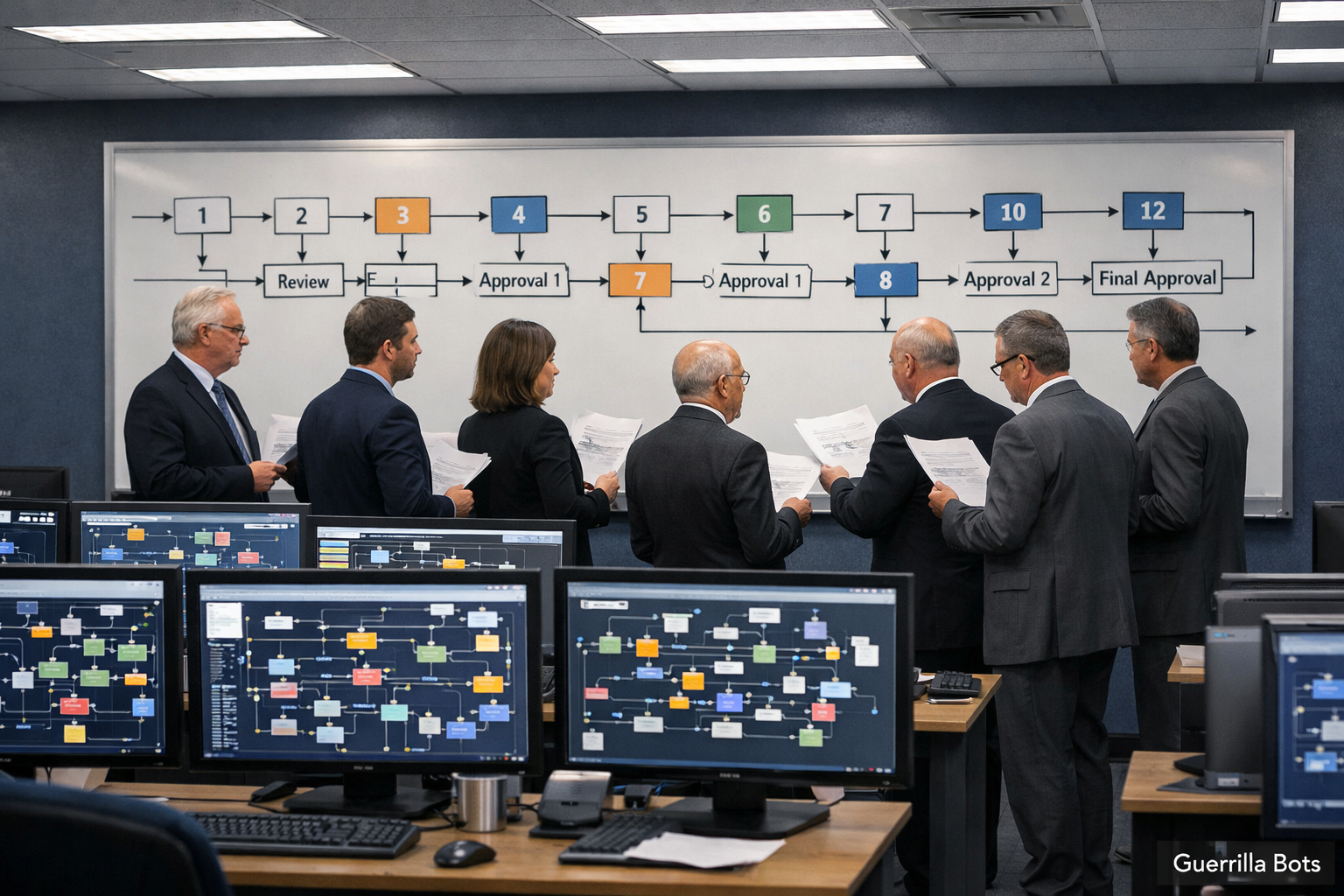
Built for high-volume, high-frequency, IT-visible processes. Invoice processing at scale. Bank reconciliation across 400 accounts. Claims adjudication with an audit trail. The kind of process complex enough to need a developer, stable enough to maintain, and large enough to survive a proper ROI filter.
The CoE model was designed for this. Developer builds the bot. CoE governs it. IT runs the infrastructure. When it works, it works at scale.
When it works.
Thirty to fifty percent of RPA projects fail outright. Forty-five percent of enterprises deal with bot breakage weekly — every SAP quarterly patch, every UI update, every CSS change breaks something. UiPath's market cap has fallen 85% from its peak. The vendors themselves are running from the category name as fast as they can.
RPA isn't dead. But it has a ceiling, and most CoEs know what the ceiling looks like — because their backlog is on the other side of it. A process that saves one person two hours a week never clears the ROI filter. A developer cannot justify three weeks of build time for something that pays back in two years. So it sits in the queue. And the queue grows faster than the CoE can hire.
Agentic Automation — the AI model
Built for variable, judgment-dependent inputs. The cases where you cannot pre-specify the steps because inputs change every time. "Look at this email and decide what to do." "Scan these invoices and flag what looks wrong." Genuinely ambiguous work where rule-based systems cannot handle the variability.
The pitch is compelling. The results are not there yet.
Only 11–14% of enterprise AI agent pilots reach full production. Gartner projects 40% of agentic AI projects will be cancelled by end of 2027. The adoption curve is not what the vendor briefings suggest.
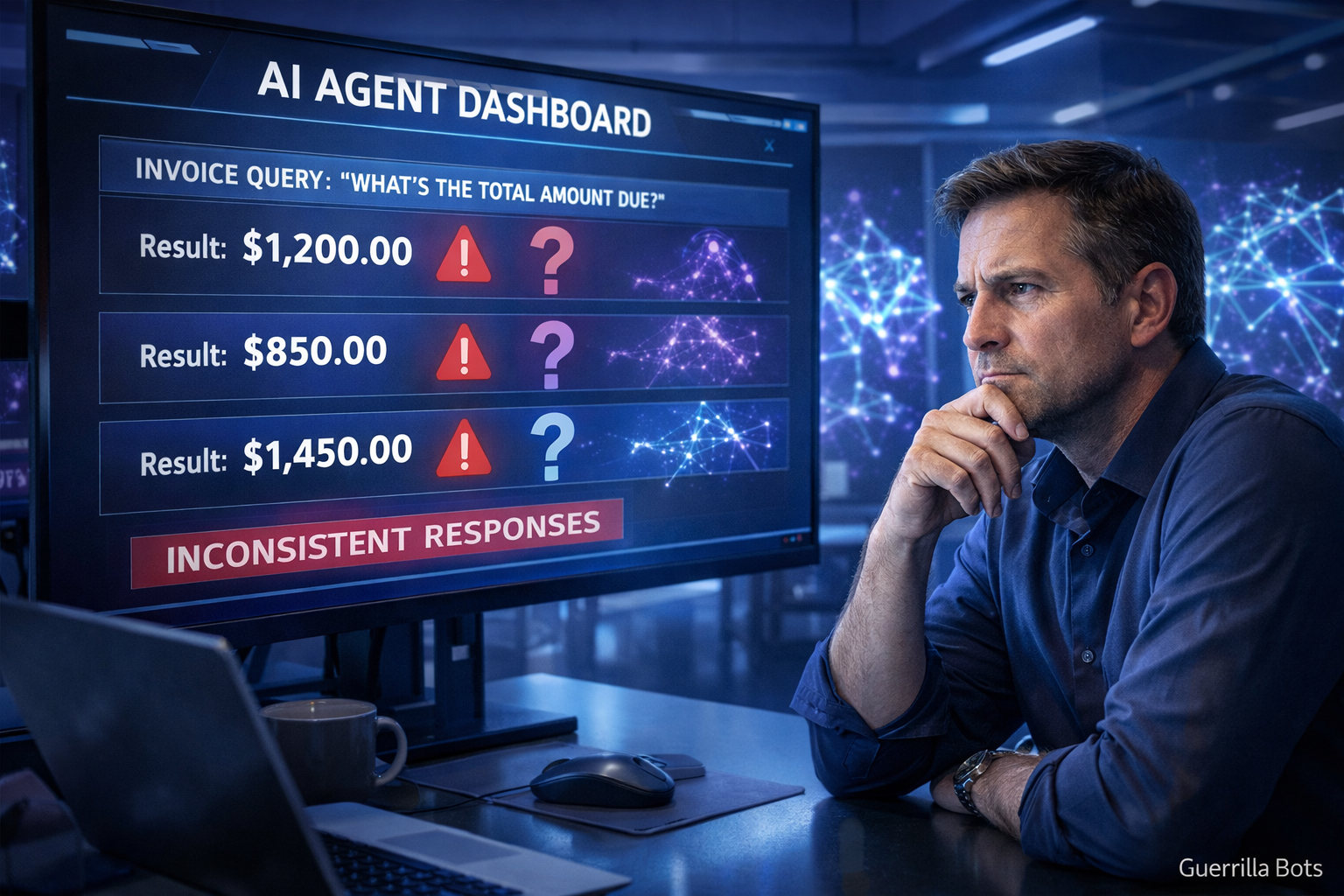
The core issue is non-determinism. An AI agent does not produce the same output for the same input every time. For a significant portion of back-office work — financial reconciliation, compliance reporting, structured data entry — that is not a feature. A finance manager is not sending month-end numbers to the CFO if a non-deterministic system prepared them. A billing executive is not running payroll on inference-based output.
Agentic AI without deterministic logic infrastructure is just more fragility with better marketing.
AI agents are the right answer for genuinely ambiguous work — where inputs vary, judgment is required, and a rule-based system would fail. Most back-office work isn't genuinely ambiguous. Most of it is structured, repetitive, and already well-understood by the person doing it.
The 50% nobody built for
Back-office work roughly splits three ways.
About 20–25% is high-volume, high-frequency, structured work — the kind enterprise RPA was built for. About 20–25% is genuinely judgment-dependent — variable inputs, where AI agents are the right tool. The remaining 50–55%: structured, deterministic, person-specific workflows that don't clear the RPA ROI threshold and don't need AI judgment. They just need the person who does them to be able to automate them.
A relationship manager who exports the same portal report every Monday and pastes it into three sheets. An operations analyst who checks six vendor sites to flag delivery mismatches. A billing executive whose entire monthly close is forty minutes of copy-paste across tabs.
Real work. Fully structured. Zero ambiguity. Will never survive a CoE ROI filter. Will never need an AI to decide anything.
This is what Guerrilla Process Automation is built for.
The practitioner records what they actually do. The bot runs it — deterministically, with the same logic the practitioner used, every time. IT approves the infrastructure once. The CoE supports without having to build every last-mile process from scratch. The person closest to the process is the person who automates it.

No code required. Deterministic execution. Practitioner-owned.
Enterprise RPA has two of the three: deterministic, CoE-owned — but it needs a developer. AI agents have one: no code — but inference-based output disqualifies them for anything financial or compliance-driven. GPA closes all three. Not by accident. Because the gap left by the other two is exactly what it was designed for.
The stack was always three tiers. Two of them have had names and vendors and conferences for years. The third — the biggest slice — has been handled manually, because nobody built a tool that was actually designed for it.
That is what we are fixing.
That is the last mile.
Written by

Pranav Neeli
12 years enterprise RPA — developer to architect to manager. Worked at Accenture, EY, Fossil, Alcon, HP. Now building Guerrilla Bots to fix the last mile.